
How To Bond and Workout with Baby

Working out with your baby isn’t just about getting your fitness back. Done gently and safely, it can become one of the sweetest parts of your day together, a bit of movement, some fresh air, and time spent close to each other while your body slowly finds its feet again.
That said, there’s a difference between exercising with your baby and rushing to “get your body back.” Most new mums feel some pressure to bounce back quickly, but recovery after birth takes real time, and pushing too hard too soon can do more harm than good. This guide is about moving at a pace that suits you, your baby, and whatever kind of birth you had.
Your body after having a baby
Pregnancy and birth change your body in ways that don’t just reverse themselves in a few weeks. Your abdominal muscles have stretched, your pelvic floor has taken a lot of strain, your joints and ligaments are still settling back into place (thanks to the hormone relaxin, which can stay in your system for months), and if you had a caesarean, you’re also healing from major surgery.
The official medical checkup usually happens around six weeks after birth, but that doesn’t mean you’re “fully recovered” by then. Some research into women’s experiences of postnatal recovery has suggested it can take closer to a year for many women to feel physically and emotionally like themselves again. Everyone’s timeline is different, and there’s no prize for getting there faster.
Try not to compare your recovery to anyone else’s, including how your body looked or felt after a previous baby. Focus on healing well, bonding with your baby, and building movement back in gradually. Being kind to yourself here genuinely helps your emotional adjustment as much as it helps your body.
When it’s safe to start exercising with baby
Always get the go-ahead from your doctor, midwife or health visitor before starting any exercise beyond gentle walking, especially if you had a caesarean, forceps or ventouse delivery, a significant tear, or any complications during birth or pregnancy.
As a general guide:
- After an uncomplicated vaginal birth, gentle walking is usually fine within the first few days, as long as it feels comfortable and you’re not overdoing it.
- Pelvic floor exercises can usually be started very soon after birth, even the day after, and are one of the most important things you can do postnatally, whatever type of birth you had.
- More structured postnatal exercise (anything beyond gentle walking and pelvic floor work) should generally wait until after your six week check, and longer if you’ve had a caesarean or any complications.
- Swimming should wait until your bleeding (lochia) has completely stopped and any wounds or stitches have fully healed, to reduce infection risk.
The American College of Obstetricians and Gynecologists (ACOG) supports women with straightforward pregnancies being active before, during and after birth, but they’re clear that this should be built up gradually and tailored to how you’re recovering. If in doubt, ask your GP or midwife specifically what’s appropriate for your situation rather than following a generic timeline.
Stop and get checked if you notice any of the following during or after exercise: increased bleeding, a dragging or heavy feeling in your pelvis, leaking urine or wind that wasn’t happening before, a bulge along your tummy when you strain, dizziness, or any pain that doesn’t ease with rest. These can be signs your body isn’t ready for that level of activity yet.
Simple, low impact ways to start
Walking
Walking with the pram or in a baby carrier is genuinely one of the best places to start. It’s low impact, easy to adjust in length and pace, and gets you both outside, which does wonders for mood on the hard days. Start with short walks around the block and build up gradually rather than aiming for a big loop straight away. If you’re using a carrier, make sure it supports baby’s hips and neck properly and check with the manufacturer’s guidance for your baby’s age and weight.
Pelvic floor and gentle core work
Before anything more strenuous, it’s worth spending time rebuilding your pelvic floor and deep core strength. Simple pelvic floor squeezes (the same muscles you’d use to stop yourself weeing) done little and often throughout the day make a real difference to bladder control and core stability long term. If you had a caesarean or suspect diastasis recti (a gap in your abdominal muscles, which is common after pregnancy), ask your GP or a women’s health physiotherapist to check before you do any traditional ab exercises like sit ups or crunches, as these can make things worse rather than better.
Yoga
Postnatal yoga is a lovely low impact option once you’re cleared to move beyond walking. It helps with flexibility, tight shoulders (from all that feeding and carrying), and general stress relief. Stick to gentle, beginner-level classes marketed as postnatal or “mum and baby” yoga, and avoid deep twists, strong backbends or anything your instructor flags as advanced. A good postnatal yoga teacher will know to watch out for diastasis recti and pelvic floor issues, so it’s worth seeking one out specifically rather than joining a general class too soon.
Swimming
Once your bleeding has stopped and you’ve had the all clear, swimming is a gentle, supportive way to move your whole body without impact on your joints. Baby swimming classes are also a lovely bonding activity once your baby has had their vaccinations and you feel ready, though check the recommended minimum age with the pool or class provider, as this varies.
Baby-inclusive strength exercises
Once you’ve been cleared for more structured exercise, you can start including your baby directly in simple strength moves. Keep the weight low (your baby, basically) and the movements slow and controlled. Stop straight away if anything feels wrong, and always support your baby’s head and neck properly if they’re under about four months old.
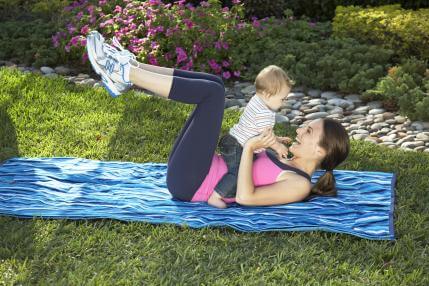
Core: modified curl up
- Lie on your back with knees bent and feet flat on the floor.
- Sit your baby on your lower tummy or upper thighs, facing you, holding them securely under the arms.
- Gently lift your head, neck and shoulders off the floor as you exhale, keeping your lower back pressed down.
- Lower slowly and repeat 10 to 15 times.
Skip this one if you have any doming or bulging along your abdominal midline, or if you haven’t yet been checked for diastasis recti.
Legs: squats with baby held close
- Hold your baby against your chest, supporting them well.
- Stand with feet shoulder-width apart and squat down slowly, keeping your weight in your heels and your knees tracking over your toes rather than caving inward.
- Only go as low as feels controlled and comfortable, there’s no need to go deep.
- Push through your heels to stand back up. Repeat 10 to 12 times.
Back and shoulders: seated baby press
- Sit cross-legged or in a comfortable seated position, holding your baby securely at chest height, facing you.
- Slowly press your baby upward, keeping your elbows soft rather than locked.
- Pause briefly, making eye contact and smiling, then lower back down with control. Repeat 8 to 10 times.
Gentle stretch: cat pose with baby
- Get onto hands and knees, with your baby lying on their back on a mat or blanket beneath you, looking up at you (this works well with slightly older babies who have decent head control).
- Round your back gently, drawing your belly button up, and lower your chin to look at your baby.
- Hold for a few seconds, then return to a neutral spine. This is more about connection and gentle movement than a hard workout.
None of these need to be done as a big structured session. Even five or ten minutes scattered through the day, done consistently, adds up over time and is far more sustainable than trying to squeeze in a long workout while you’re exhausted.
Bonding is about more than the exercise itself
The physical movement is only part of what makes these sessions valuable. Talking to your baby throughout, making eye contact, narrating what you’re doing in a silly voice, all of that builds connection just as much as the exercise does. Babies respond strongly to your face and voice, so slow, deliberate moves where you’re looking at each other tend to be more engaging for them than fast repetitions where they’re just along for the ride.
If your baby gets fussy or overstimulated, that’s a good cue to stop and just have a cuddle instead. There’s no target to hit. Some days you’ll manage ten minutes, other days none at all, and that’s completely normal with a small baby in the house.
Looking after your mental wellbeing too
The first months after birth, often called the fourth trimester, can be an emotional mix of overwhelming love and sheer exhaustion, sometimes within the same hour. Movement genuinely helps a lot of people feel better mentally, gentle exercise has been linked with improved mood and lower rates of low mood and anxiety in general populations, though it’s not a substitute for proper support if you’re struggling.
If you’re feeling persistently low, anxious, or not yourself in the weeks after birth, please speak to your GP, midwife or health visitor. Postnatal depression and anxiety are common and very treatable, and reaching out early makes a real difference. Exercise can be a helpful part of feeling better, but it isn’t a fix on its own.
The bottom line
Your body has just done something extraordinary, and it deserves patience, not pressure. Get cleared by a health professional before ramping up your activity, start gently, and pay attention to how your body responds as you go. Beyond that, try to enjoy this window with your baby for what it is. They’re only this small once, and a slow, happy recovery will serve you both far better than rushing to tick a fitness box.
Share This Story, Choose Your Platform!


Latest Post


Latest News To Your Inbox
Subscribe to hear about our latest blog posts, competitions and special offers.