
Parent/Child Bonding: Songs to Sing to Baby

Singing to your baby is one of the simplest, cheapest and most effective ways to bond with them. It costs nothing, you can do it anywhere, and you don’t need a “good” voice or any musical training to get the benefits. If you’ve been putting off bonding activities because you feel silly singing out loud, this is your sign to just go for it.
A lot of parents feel self-conscious about their singing voice. You might worry you sound flat, or that a passing stranger will hear you murdering “Twinkle, Twinkle”. Here’s the thing though: your baby has no idea what a “good” singer sounds like. She isn’t judging your pitch. What she responds to is the warmth, rhythm and familiarity of your voice, which is already the sound she knows best in the world.
Research into infant behaviour has found that babies tend to stay calm for noticeably longer when they’re listening to singing compared to ordinary speech. It makes sense when you think about it: singing slows down speech, exaggerates the rhythm and pitch, and repeats itself, all things that help a baby’s developing brain latch onto patterns. Some researchers who study early language development also think that singing to your baby, even before she can understand a single word, helps lay groundwork for later speech and language skills. If you ever have concerns about your child’s hearing, speech or development, it’s always worth raising them with your health visitor, GP or paediatrician, but singing itself is a low-risk, high-reward activity you can start straight away.
When and Where to Sing to Your Baby
There’s no rulebook here. If your baby is grizzling in the supermarket queue, a quiet “Itsy Bitsy Spider” under your breath is completely normal and often works better than you’d expect. Singing doesn’t need its own special time slot, it can slot into nappy changes, car journeys, bath time, or the walk to the shops. Some parents like to build it into set moments of the day (a wake-up song, a bath song, a bedtime song) because babies genuinely do pick up on these little routines and find comfort in the repetition.
Your baby could hear your voice from around the third trimester of pregnancy, roughly from 25 to 27 weeks onward, muffled through fluid and tissue but still recognisable in rhythm and tone. By the time she’s born, your voice is already familiar and soothing to her, which is part of why singing works so well even in the newborn weeks when everything else feels new and overwhelming.
Types of Songs to Sing to Baby
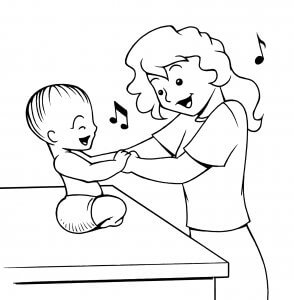
Don’t get stuck worrying about which songs are “correct”. There’s no official list. What matters most is your voice, your presence, and a bit of consistency. That said, different types of songs do different jobs, so it helps to have a small mental library for different moments of the day.
Modern Songs
Most modern songs work perfectly well for babies, as long as you’re comfortable with the lyrics (save the explicit stuff for your headphones). Babies respond particularly well to songs with a strong, steady beat and repeating chorus, because their brains are wired from birth to notice patterns, and there’s something satisfying for a baby in “predicting” what comes next in a song they’ve heard a few times.
Pop songs also give you a chance to be a bit silly, put on a voice, or add actions, which babies find genuinely entertaining to watch. A few that work well as sing-along material with a baby or toddler in tow:
- “Three Little Birds” by Bob Marley
- “Just the Way You Are” by Bruno Mars
- “You’re Beautiful” by James Blunt
- “Shake It Off” by Taylor Swift
- “Dancing Queen” by ABBA
- “Isn’t She Lovely” by Stevie Wonder
Lullabies

Lullabies have been used for generations for a simple reason: a slow, soft, repetitive song helps signal to a baby’s nervous system that it’s time to wind down. You don’t need to sing them perfectly, or even sing real words. Plenty of parents hum a made-up tune or repeat “shhh, shhh” in a sing-song rhythm and it does exactly the same job.
Using the same lullaby, or a small handful of them, as part of your wind-down routine can genuinely help with settling over time, because babies start to associate the sound with sleep. It’s worth being patient with this though: it usually takes weeks of repetition before a song becomes a reliable “sleep cue” rather than just a nice sound.
Lullaby Songs to Try
These are all short, simple, and easy to sing softly. If you don’t know the words, they’re easy to look up:
- You Are My Sunshine
- Twinkle, Twinkle Little Star
- Somewhere Over the Rainbow
- Rock-a-bye Baby
- Brahms’ Lullaby
- Baby Mine
Other Bedtime Songs

Beyond traditional lullabies, plenty of gentle, slower songs work well right before sleep. If you like the idea of playing music quietly in the background as part of the wind-down, a small speaker in the nursery can work well, but keep the volume low (roughly the level of a quiet conversation) and set a timer or turn it off once your baby is asleep rather than leaving it playing all night. Some good bedtime choices:
- Hush Little Baby
- “Blackbird” by the Beatles
- Silent Night
- “The Rose” by Bette Midler
- Frère Jacques (Are You Sleeping?)
- Amazing Grace
If you’re building a proper sleep routine for your baby, singing the same one or two songs at the same point every night (after the bath, before the last feed, whatever order works for you) can become a really useful cue that bedtime is coming, alongside dimmed lights and a calm voice.
Nursery Songs
Singing isn’t only about settling your baby. It’s also a brilliant, low-key way to play, make her laugh, and build early language skills. Nursery rhymes in particular tend to have simple rhyming structures, repeated phrases and predictable rhythms, all of which make them easy for a developing brain to latch onto. Many local libraries, children’s centres and baby groups run free “rhyme time” or singing sessions too, which are worth looking into if you fancy some company (and a reason to leave the house).
Classic Nursery Rhymes
These have been sung to babies for generations for good reason: they’re short, rhythmic, and often come with actions your baby will eventually copy back.
- Row, Row, Row Your Boat
- London Bridge
- Old MacDonald Had a Farm
- The ABC Song
- Itsy Bitsy Spider
- Pat-a-Cake
Modern Nursery Songs
Plenty of newer songs, from children’s TV shows and modern kids’ musicians, do the same job as the classics while adding some fresh energy for you as the parent. These are a solid addition to your rotation:
- “Skinnamarink” by Sharon, Lois and Bram
- “Apples and Bananas” by The Wiggles
- Kumbaya
- The Wheels on the Bus
- Five Little Speckled Frogs
- Five Little Monkeys
- Head, Shoulders, Knees and Toes
A Few Practical Tips
If you’re still feeling awkward about singing, start small. Hum a tune while you’re changing a nappy, or sing quietly during a feed when nobody else is around. It gets easier with practice, and most parents find that after a week or two it stops feeling strange altogether.
Adding simple actions (clapping, tickling, bouncing gently on your knee) makes songs like “Row, Row, Row Your Boat” or “Pat-a-Cake” even more engaging, since babies love watching faces and movement as much as hearing sound. As she gets a bit older, pause before the “surprise” moment in a song (the “boo!” in Peekaboo-style songs, for instance) and watch her anticipate it. That kind of call-and-response play is genuinely good for her developing sense of rhythm and turn-taking.
Whatever you choose to sing, your baby isn’t listening out for perfect pitch. She’s listening for you. That’s really the whole point of it.
Share This Story, Choose Your Platform!


Latest Post

Latest News To Your Inbox
Subscribe to hear about our latest blog posts, competitions and special offers.